






Collect the Spectacular. Introducing Super Stickers: Spectacular Series
The next chapter in the VeeFriends Super Stickers series has arrived. Released in August 2025, Super Stickers: Manga Series featured a…
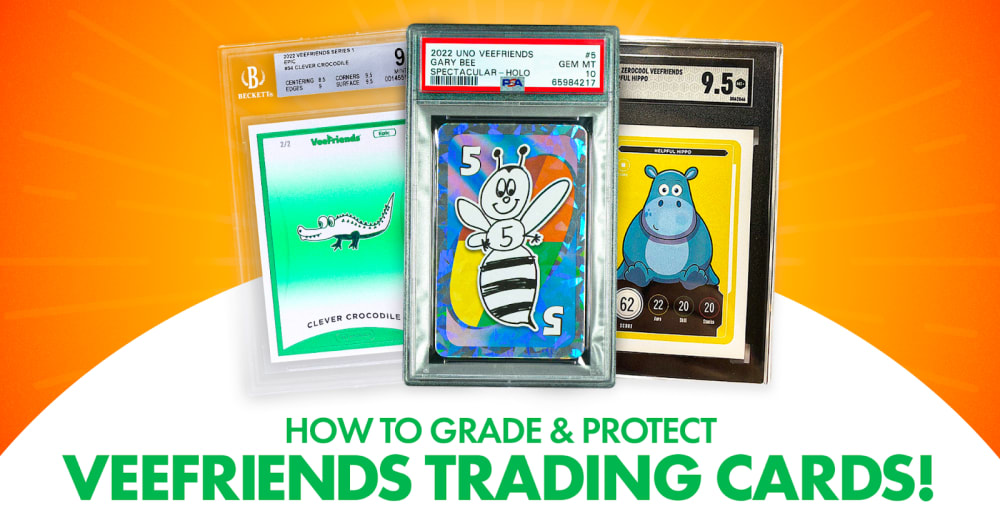
The excitement is at an all-time high as VeeFriends physical collectibles make their way to community members and collectors! There have been three special collectible card products released to date: VeeFriends UNO, VeeFriends Series 1 Cards, and VeeFriends Compete and Collect. Whether you're ripping a box of Compete and Collect, opening a deck of UNO, or tracking down your favorite Series 1 card, we are excited to see so many incredible VeeFriends cards in the wild. When you begin to open and collect these cards, they can be kept as is, or sent to a third party for a professional authentication & condition grade.
Whether you are a seasoned collector or new to the trading card scene, we believe it is important for the community to learn about different ways of authenticating, protecting, and grading these trading cards! Let's dive in on everything you need to know about enjoying and preserving your VeeFriends hits!
There is no right or wrong answer to this question, it's about doing what is right for you as a collector. Grading a card allows for official authentication and scoring of the card, and a higher grade typically brings more value. On the other hand, many prefer to keep cards ungraded for their collection. Sending a card for grading does cost money and has different turnaround times to receive it back. This decision should be made based on your personal desires and research! Whether you are looking to keep your cards as is or send them for grading, this blog will outline many essentials to proper storing and management of your pulls!
There are several ways trading cards can be kept: In the trading card world, the term "raw" refers to keeping a card ungraded. Grading a card means sending it to a third-party professional to evaluate and score the condition and authenticity of a card. Cards are graded based on their appearance and condition, with the process carefully evaluating the condition of a card's corners, edges, surface, and centering.
When a card is graded, it is assessed a score between 1 (lowest) and 10 (highest), and then encapsulated in a protective plastic holder with a label stating the card's title, authenticity, and condition.
The condition of a card is scored with a numerical grade and one of the following: Gem Mint, Mint, Near Mint to Mint, Near Mint, Excellent-Mint, Excellent, Very Good, Good, Fair, Poor. Even one tiny imperfection on the card could negatively affect the overall grade it receives.
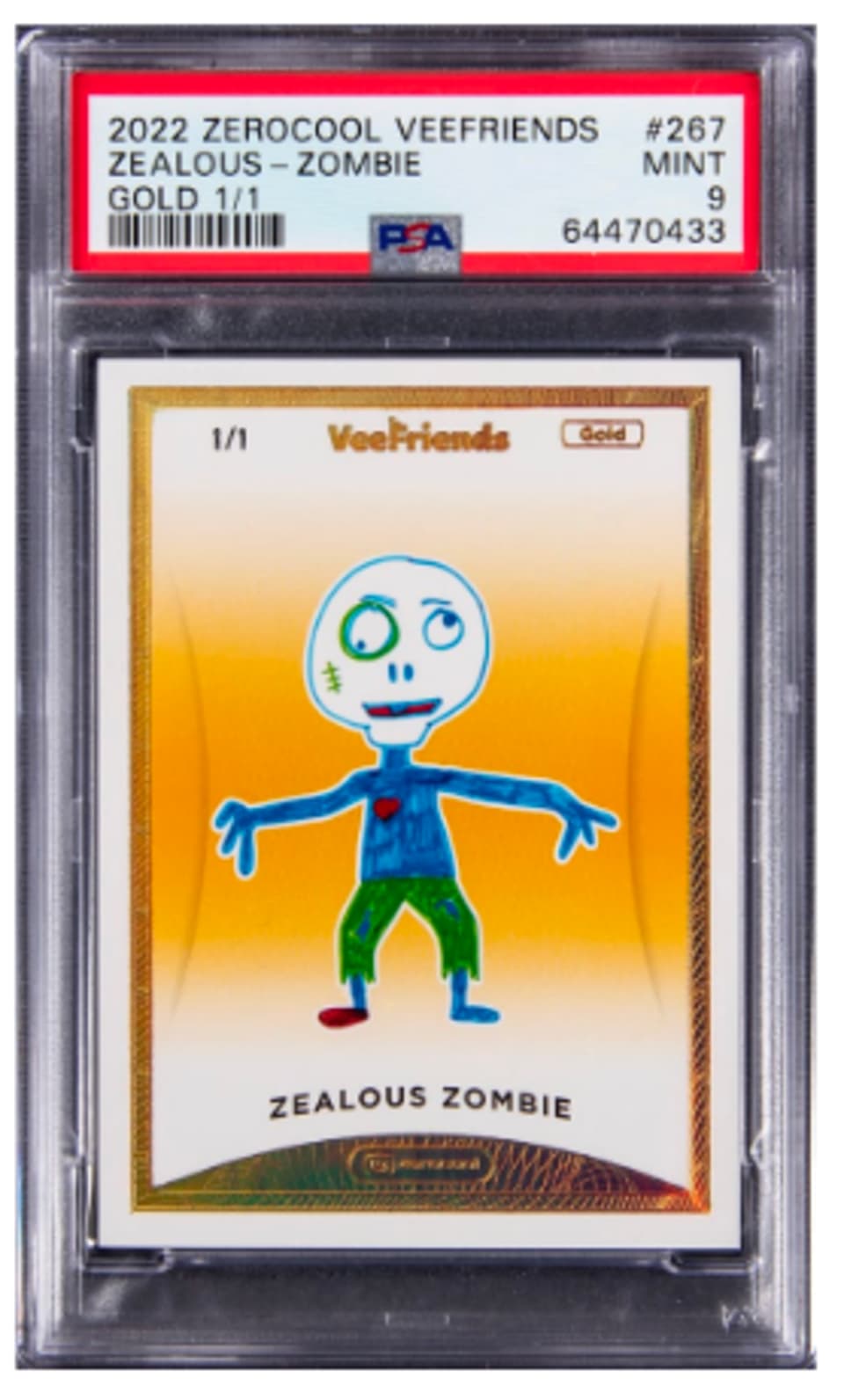
It is important to understand that there are many variables that come into play when evaluating a card's condition, and a perfect Gem Mint 10 grade is quite difficult to achieve. Moreover, a card does not have to be graded in order to collect and enjoy! It is a decision based on personal preference, cost, and turnaround time.
A measurement of how well-centered a card comes out of the pack, both left to right and top to bottom is taken into consideration. It's a measurement of how much more/less border there is on each side of the card relative to the other sides. A card does not need to have precise 50/50 centering to receive a perfect grade, but if it's very noticeably off-centered, then you may be better off keeping it raw.
Sharp corners are a general standard across grading companies. For a card to be evaluated as "Gem Mint," it requires sharp corners on both the front and back of the card. It is also important to note that what may seem perfect to the naked eye may look different to a professional viewing it with magnification.
The surface of a card is an important factor in the grading process. Any scratches, indents, creases, blemishes, print defects, or fingerprints on a card's surface could have a negative impact on the grade. This is why when opening cards, it is best to hold the cards by the edges to not get fingerprints on the card.
*Helpful Tip: Hold your cards gently by the edges! Gloves are worth considering when opening packs if you prefer to be ultra careful, and a microfiber cloth is a great tool for cleaning the surface of a card. Carefully wiping the card clean with a microfiber cloth such as these can help avoid an unnecessary low grade due to fingerprints or dirt on the surface.
When looking at the edges of a card for it to receive a Gem Mint grade, there should be minimal evident chipping or whiting. Again, it could be difficult to see issues with a card's borders with your naked eye, so a loupe or other type of magnifying glass could help get a closer look at the card. If there aren't any notable blemishes on the edges, then you are probably in good shape for this part of the grading process!
*Important Fun Fact: You can also send a card to grading companies to grade a card as "authentic," with no numerical grade assigned. This is best for guaranteeing the card is genuine and most commonly used purely for protection and display purposes.
PSA has emerged as the largest card grader on the market. While there are pros and cons to different companies, PSA-graded cards tend to carry a premium in the aftermarket compared to other third-party graders. Cards are graded on a 10-point scale from 1 through 10, with 10 (Gem Mint) being the highest. PSA does not evaluate in half-points (such as 8.5 or 9.5). Throughout all trading cards, receiving a 10 grade is quite a challenge, as the card should be virtually perfect. PSA also has an electable option to grade the autograph on a card from 1 to 10!
Guide to submitting your cards to PSA for grading https://www.psacard.com/resources/gradingstandards/#cards
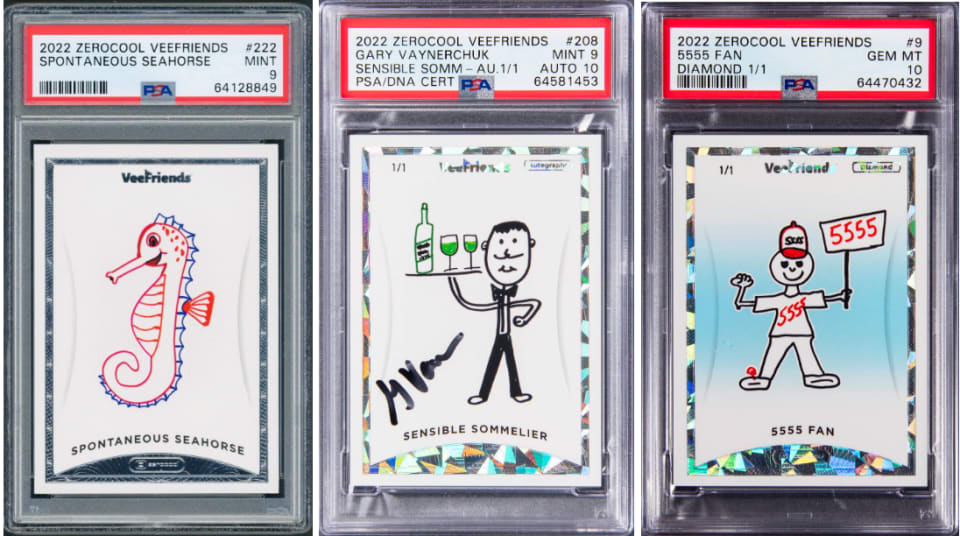
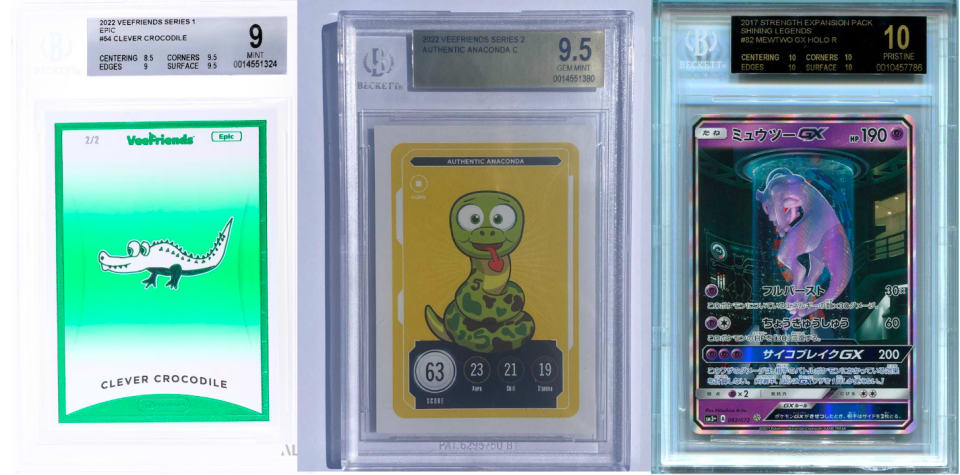
BGS has very sturdy slabs and utilizes a "Report Card" like system that helps separate it from other grading services. Through their grading process, evaluated cards are provided with four different sub-grades based on the following criteria: Centering, Corners, Edges, and Surface. Think of it as a "report card" for your card, providing clear details as to why it received its grade.
Beckett offers half-point scoring, and the BGS 9.5 is known to be their "Gem Mint" grade, with a Pristine 10 being the almost unreachable "Pristine." Beckett also has what is known as the "Holy Grail" of sports card grading; if a card has a perfect 10 score on all four subgrades, it receives a special black label to mark absolute excellence. There is also a lower-cost option to grade with BGS without subgrades. Beckett grades all autographs on cards from 1 to 10 as well.
Guide to submitting your cards with BGS: https://www.beckett.com/grading/about
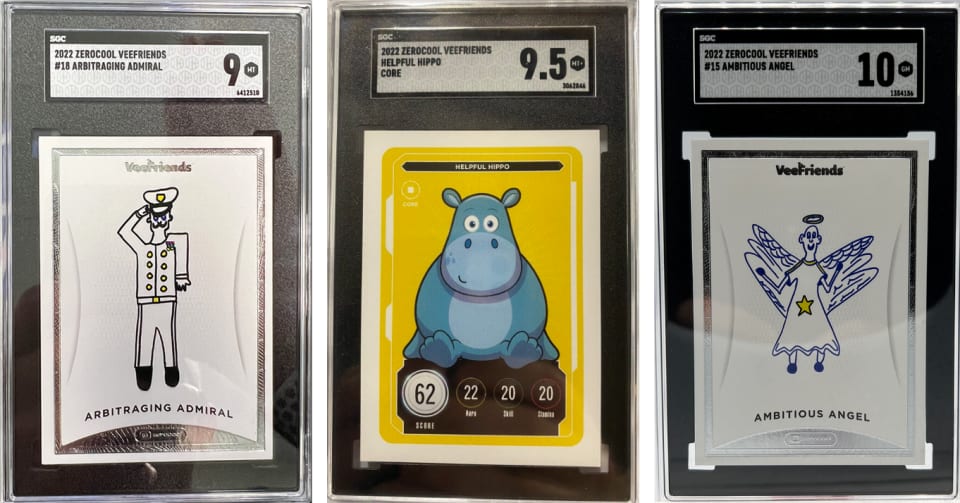
SGC has grown in popularity and uses a slique black insert in the protective cardholders. Similar to PSA and Beckett, SGC graded cards using a 1 to 10 scale. Their Gem Mint condition cards are awarded a 10, and a virtually perfect card is awarded a special gold label Pristine 10. SGC also awards half-point grades (8.5, 9.5).
Guide to submitting your cards with SGC:
https://gosgc.com/card-grading/submissions
If you have cards that you would like to keep as "raw", also known as ungraded cards, there are a couple of great ways to keep them safe and sound! Here is what you will need to protect your VeeFriends trading cards:
To keep your cards safe, you will want these two essential pieces:
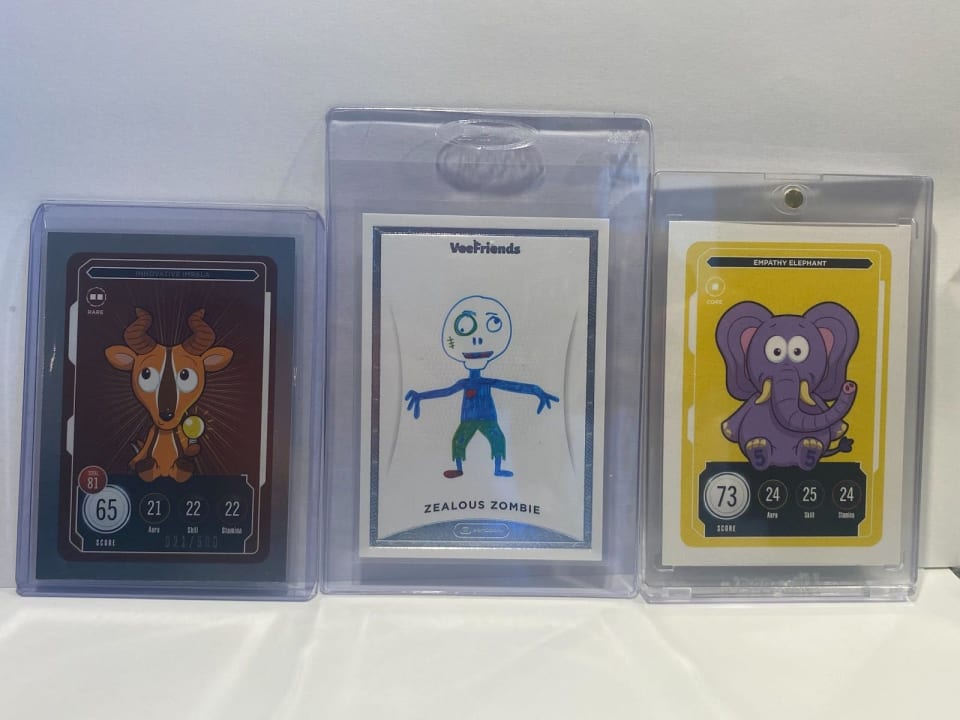
A penny sleeve is a soft sleeve that holds the card safely, and protects it from any scratching, fingerprints, or moving around in the larger top loader case.
A top loader is a harder, plastic sleeve that acts as a shell to keep the card truly protected. With this method, the cards are protected and easily stored.
All of the VeeFriends Compete and Collect and UNO cards fit in fit in standard-sized, 20pt top loader. VeeFriends Series 1 trading cards use thicker cardstock and while they do fit in standard penny sleeves and top loaders, a 59pt top loader is great too! There are many available brands and quantities to purchase standard top loaders, and most card shops carry these supplies as well.
Another item that protects all VeeFriends cards is called semi-rigid card savers. These are hard plastic sleeves and are preferred to be sent in this way by grading companies. For protection purposes, both semi-rigid card savers and top loaders are perfect and you could go with whichever you prefer!
For the highest level of protection, there is a hard case called a one-touch magnetic. They are very sturdy, use a magnet to hold the case together, and have corner slots to keep the card in great condition! They are more expensive, but provide great protection and display for your cards! For these, be sure to use 35pt holders, the thinnest available size.
Standard Penny Sleeves - Works for all cards
Standard Top Loaders - Works for all cards (or 59 pt for Series 1)
Penny Sleeve and Top Loader Combination
Card Savers - Works for all cards
Ultra Pro Magnetic Cases - works for all cards
Each company has its requests for submitting cards to be graded. We highly recommend the "DYOR"(Do Your Own Research) method and suggest checking out and reading all of the pricing, turnaround times, and guidelines before submitting to a grading company to see which is best for You. See below for more helpful research on the mentioned grading companies:
https://blog.psacard.com/2020/08/07/journey-of-a-psa-card/
https://nerdable.com/card-grading-101-psa-vs-beckett-vs-sgc/
https://cardreviewclub.com/psa-bgs-sgc/
We hope this information helps you along your VeeFriends collecting journey! Don't forget to share any of your VeeFriends trading cards experiences by tagging @veefriends on social!
The next chapter in the VeeFriends Super Stickers series has arrived. Released in August 2025, Super Stickers: Manga Series featured a…

A new chapter awaits for BOOK GAMES tokens. Immutable X (IMX) recently sunset its original architecture and moved to a zkEVM model. As a…

We’re excited to introduce the VeeFriends Wallet powered by Privy: a secure, onchain wallet built directly into your VeeFriends account…

Be like Knowing Gnome - never miss exclusive VeeFriends updates, drops, and news! Get it all delivered straight to your phone by email and text!